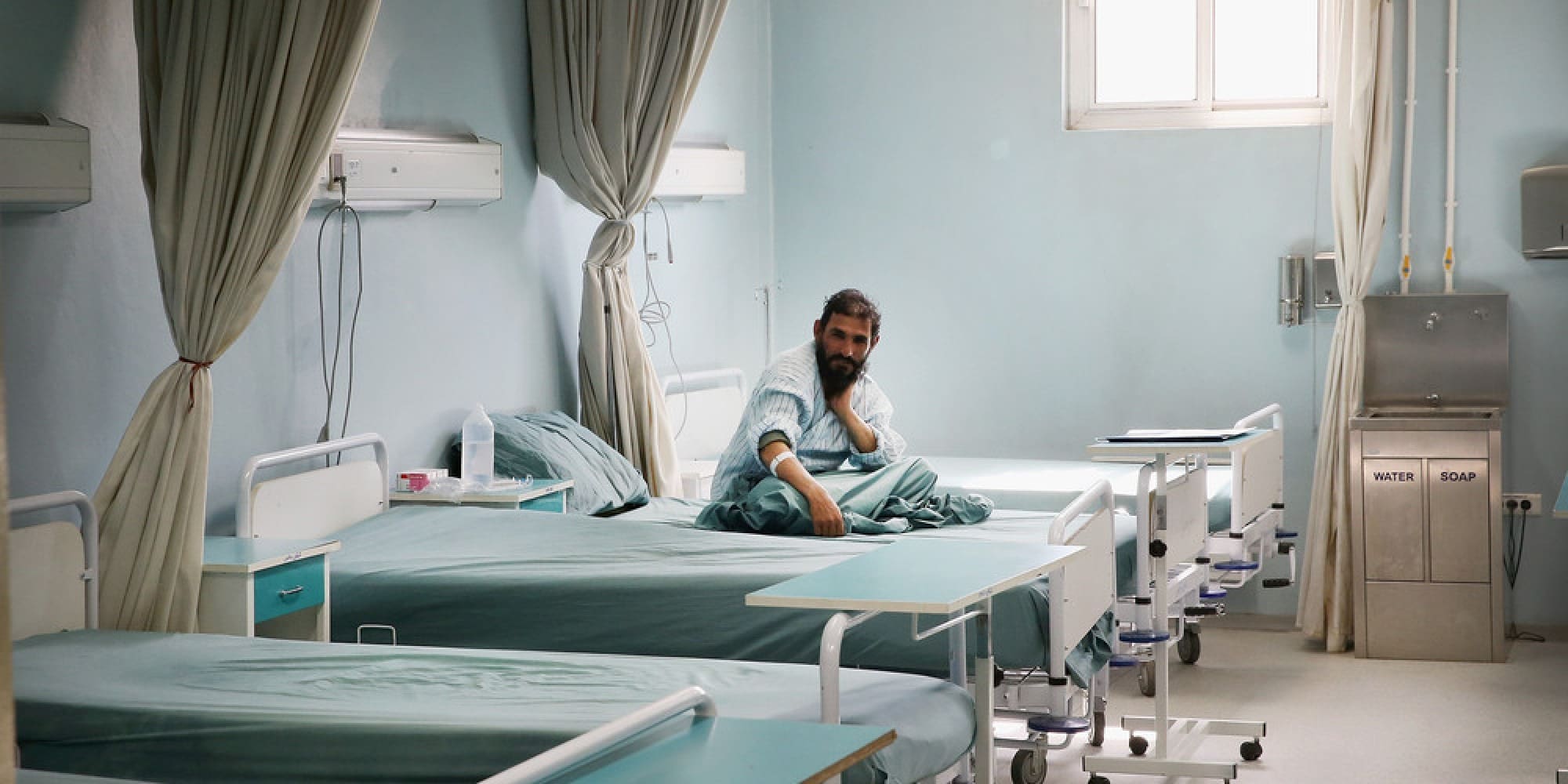
Legs tremble, hands shake, and eyes wander. No one is calm, and only a few people in the hospital waiting room attempt small talk with the person beside them—words wrapped in innocent lies meant to comfort shattered hearts.
Illness—especially when acute or life-threatening—unwillingly exiles a person to another realm, a different air and world; to a community for whom the hospital is the constant and familiar passage. And worse still when these silent convicts find themselves exiled to hospitals in Kabul.
Even the word for this place stings. Bimarestan—a “land” of the ill, much like “Afghanistan,” “Pakistan,” and all the other “-stan”s. The moment you step inside, it feels as if you’ve entered another territory, another sky. And that is the truth: you are torn away from the world of the healthy. Here, in every corner, only one thing flows—an unending struggle for survival.
The fear healthy people feel toward hospitals cannot simply be reduced to the fear of catching an infectious disease. A healthy person does not want to witness this maddening “land.” They prefer to deny its existence entirely, keeping thoughts of it far away from the dreams of a triumphant life. They push away any sense of proximity to death as quickly as possible. Their fear of the hospital is not merely the fear of becoming ill, but the dread of confronting the final anxiety of existence.
And as with everything else in the social life of humans steeped in the filth of neoliberalism and capitalism, hospitals and their desolate inhabitants are defined by class. From the enormous differences between hospitals in the U.S., Europe, or even cities like Karachi, Delhi, and Hyderabad—compared to the hellscape here in Kabul—to the internal divides created by patients’ unequal financial means, the result is clear: a hospital in New York, London, or Vancouver bears little resemblance to a hospital in this dystopian nightmare.
In this place, where the presence of death reaches its cold logical conclusion, the miserable patient measures what little fortune they have against the miseries of others. And most miserable of all is the one for whom death is no longer a possibility among possibilities, but an approaching certainty—staring directly into their eyes without mercy.
Kabul adds another element to the despair of its patients: distrust. In a city where doctors emerge from medical schools armed with money, recklessness, and family connections rather than knowledge, one cannot place the same trust one would in Hippocrates or Fleming. The Kabul patient knows, deep down, that their desperation to hold onto the shrinking circle of life becomes an opportunity for wealthy hospital owners: a chance to empty already-empty pockets and stretch out their helpless hand before a crowd of the unscrupulous. The patient knows not whom to trust—or how.
These silent convicts, cast out from the land of health and well-being, are the loneliest of all. Their suffering satisfies no human longing for a noble death; they are too many, too repetitive. And the most honest reaction anyone—anyone with a trace of humanity—can muster is: “I’m sorry, but what can be done?” Though much could be done—and humanity has not done it, and perhaps never will.
I have always hesitated between two words for this melancholic, maddening place: bimarestan and shafakhana—the latter undeniably more beautiful. But in Kabul, how many of these places truly deserve to be called shafakhana, a sanctuary that sends you back smiling to the circle of healing? And how many are instead the land of silent, hopeless, and—at best—barely hopeful plague-stricken souls: hospitals in the starkest, bleakest sense? Fortunate will be the day when this city can call more of them shafakhana—places of healing—rather than bimarestan, domains of the afflicted.