
In recent days, a video has circulated on social media showing an incident on a Kabul street: ordinary, unarmed people confronting and resisting the bullying of several Taliban soldiers. Among the many reactions to the video, the strongest has been praise—praise for the spirit of resistance that still lives among ordinary Afghans. Some viewers saw this defiance as an act of bravery. Others described it as a natural, inevitable response to the behavior of such an authoritarian, totalitarian regime. According to them, “people’s patience has limits,” and sooner or later, buried anger and frustration erupt into the open.
But perhaps many of these reactions are shaped by distance—distance from Afghanistan’s daily realities and from the lived texture of its history. What justifies the assumption that this incident is the only act of resistance in the past two years? By what measure can one claim that society, as a whole, has remained silent and passive? And if no “library-based,” academic study exists on the matter, then what do Kabul’s streets themselves tell us? Come walk with me as we “read” these streets.
With the arrival of September, Kabul’s air begins to resemble a garden’s breeze—steady winds, heat that is still warm but no longer scorching, air not yet suffocated by the smoke and dust of winter. People come out in the late afternoon, hoping the wind will carry away some of the heavy burden of being alive. Two years have passed since they fell from the ship meant to carry them to safety and prosperity—two years since its sails were torn, leaving them stranded in a turbulent, hostile sea. “Two years and some days and some hours…” Time has thickened and multiplied for them; years have become long years, and now even longer.
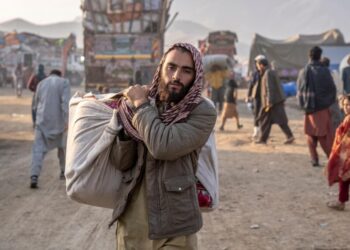
And silence rules—absolute silence in crowds where no one speaks unless compelled to. Every face is turned inward, every brow furrowed, and greetings receive no reply. People stand lost in thought. Under the blazing sun, children emit a faint scent of sickness as they roam the alleys with large, dirty sacks in search of empty bottles. Even in them, no trace of lightness or childhood remains.
But in the dark sky of this wounded city’s collective history, a few small stars still flicker. Tiny, yes. Too small to illuminate such vast darkness. But they exist—and they shine for themselves. A young woman walking with books in her hands toward some unknown place of study—wherever it may be—is a small act of defiance. A cart-pusher who must sell his goods on the roadside—who returns every time the regime’s enforcers whip him away—stands because he has no choice but to stand. A small, mobile children’s library, stripped of its former bright colors, still roams Kabul’s streets—its very movement an act of defiance against those who boast of never having read a single book.
And then there is the young man walking with headphones, singing aloud to the music—knowing full well that this simple act contradicts the shadow that now governs the city and its patrolling soldiers. Yet he walks. He sings. And in his radiant expression, one can tell that he understands not only the beauty of the music but also the beauty of the act itself.
Why do such small things stand out now? Why do they shine so sharply? Because the darker the backdrop, the more visible every spot of light becomes. There is no doubt that these acts of resistance are tiny and, in the grand scale of the country’s crisis, ineffective. But we must remember that this city is half-alive. A city where people clung to airplane wings in desperation—young men, sensible and grown, clung to them and fell and died. As tragic as that. And that was not the beginning, nor the end. Life in this city has endured torture for many years—far too many.
These small stars, these faint sparks of life, are fragments of a quiet message whispered through a strained, suffocated voice:
“I am still alive…”