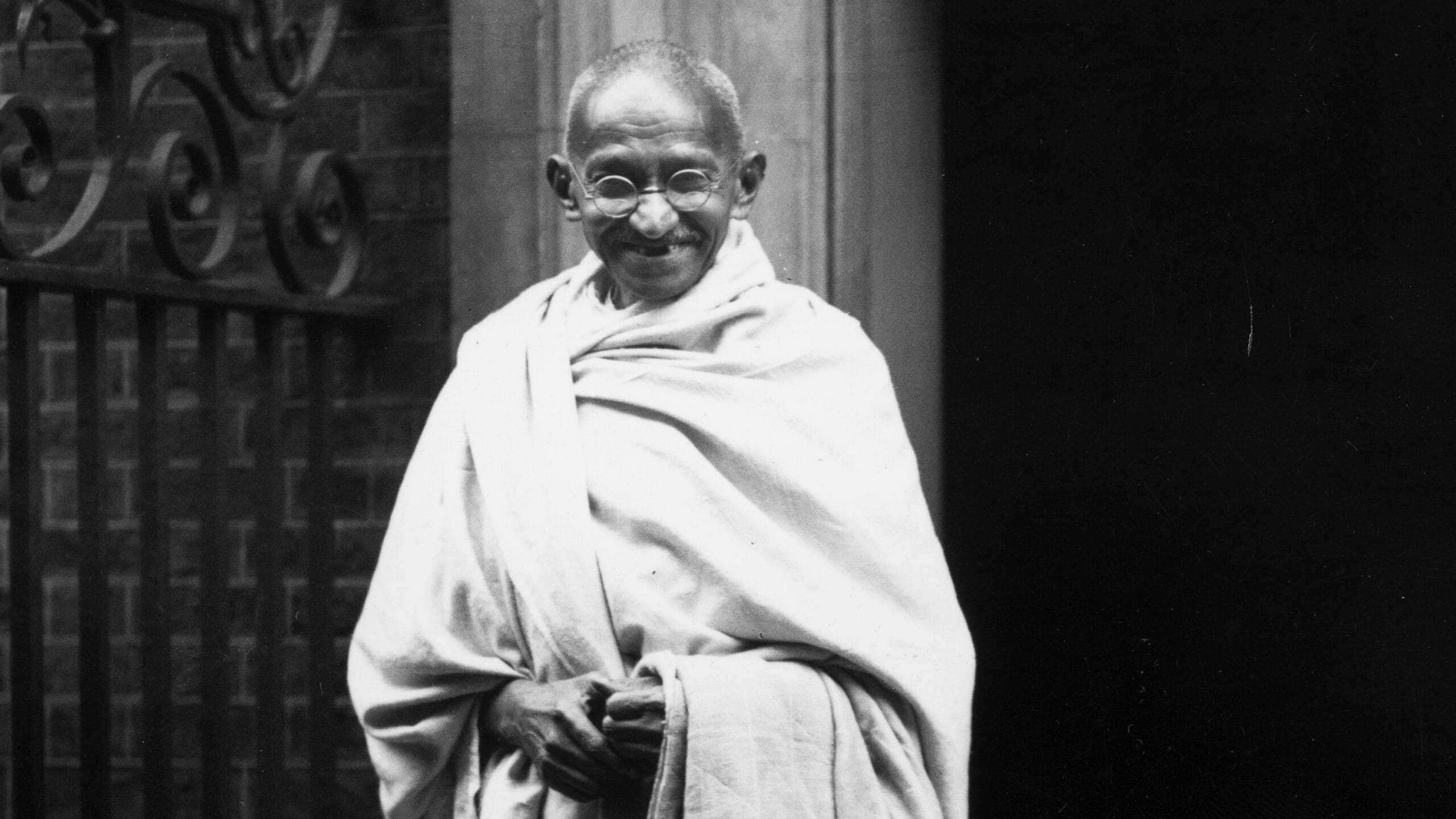
January 30 marks the anniversary of the assassination of Mohandas Karamchand Gandhi — lawyer, leader of India’s independence movement, and one of the most influential political figures of the modern era. A frail, soft-spoken man who believed that nonviolence could liberate the Indian subcontinent from the grip of the world’s largest empire, Britain.
There is much to know about Gandhi’s life — from the fact that “Mahatma” was not his name but an honorific meaning “great soul” in Sanskrit, to the remarkable letter he once wrote to Adolf Hitler.
What do we know about the extraordinary and eventful life of Mohandas Karamchand Gandhi? What value does understanding him hold for a society like Afghanistan? Are his principles “naive optimism,” or a practical option for confronting injustice?
Gandhi was born on 2 October 1869 into a respected and religious Hindu family. He was the third child of his father’s fourth wife. His sister Raliat described Gandhi’s childhood as mercury-like — a playful, active boy full of energy, in contrast with the contemplative, solitary figure he would later become.
G. Ramachandran, in his book Gandhi Before India, wrote that Gandhi was deeply influenced by his mother, a woman so devout she would not eat before praying, and who honored even her most difficult vows. Fasting for two or three days was, for her, entirely ordinary.
A child raised in such a household was destined to see life as an ascent — a continuous struggle to rise and to uplift.
At thirteen, following customs still common in parts of the East, Gandhi was married to a fourteen-year-old relative. He later wrote that at the time, marriage meant little more to him than “wearing new clothes, eating sweets, and playing with other children.”
His autobiography contains many striking details about this early marriage — rapid emotional growth, youthful desires, and the guilt that haunted him, including his memory of leaving his dying father’s bedside to visit his young wife. The anguish of that moment stayed with him for life.
At sixteen, he and his seventeen-year-old wife had a son who survived only a few days.
In 1888, shortly after the birth of his first healthy child, Gandhi traveled to London. Before he left India, his mother made him swear he would abstain from meat, alcohol, and women in Britain. Gandhi kept his promise; his involvement with the London Vegetarian Society reflects that commitment.
In 1891, after learning of his mother’s death — news that reached him late — he returned to India. Soon after, an acquaintance helped him secure work in Johannesburg, South Africa.
Gandhi remained in South Africa for 21 years. His political awakening and understanding of injustice were deeply shaped by his experiences under the country’s racial apartheid system — a system later dismantled by another nonviolent fighter, Nelson Mandela.
Gandhi’s brown skin — ordinary in the East — was intolerable to the enforcers of apartheid. He was thrown off a train, forced to sit on floors in public transport, and beaten by police for resisting racial discrimination.
Although initially planning to return to India in 1894 after completing a legal case, Gandhi stayed to organize and advocate for equality. It was in South Africa, through struggles including the Boer War, that he reached two key realizations: first, that despite thinking of himself as a “British subject,” he was seen by others simply as Indian; and second, that nonviolent resistance produced deeper, more enduring change than violence.
During this period he founded a newspaper, Indian Opinion, which examined issues in South Africa and India through a justice-oriented lens.
In 1915, at the request of Gopal Gokhale, a leader of India’s independence movement, Gandhi returned to India. His arrival reinvigorated the Indian National Congress. By 1920, he had become its leader and reorganized the independence struggle around his philosophy of civil resistance. Over time, the movement grew into a mass national campaign impossible for the British Empire to ignore.
Their demands intensified through the 1930s. On 26 January 1930, the Congress declared India’s independence — a declaration Britain refused to recognize, though London later agreed to grant limited local governance.
World War II and mounting tensions led Gandhi in 1942 to call for immediate independence. Britain responded by imprisoning him and tens of thousands of Congress members.
The struggle escalated until 1947, when a weakened postwar Britain agreed, in cooperation with the Muslim League, to partition the subcontinent into the independent states of India and Pakistan — a decision contrary to Gandhi’s hopes for a united country.
A year later, Gandhi was assassinated by an Indian extremist angered by the partition and Gandhi’s perceived role in it.
Jawaharlal Nehru, India’s first prime minister and Gandhi’s close protégé, told the nation: “The father of our nation is gone, and we can no longer run to him for guidance and comfort.”
Gandhi’s life was filled with events that shaped history — not only witnessing its course, but actively altering it through sheer will. He even wrote a letter to Hitler urging him to use his power for peace, and responded to historian Will Durant with reflections on the meaning of life.
His minimalism and simplicity stood in stark contrast with his extraordinary influence. Though he became the moral successor to the British Raj, he had no desire for power. His simple white cloth became a symbol for millions seeking freedom.
His influence extended far beyond the subcontinent: Mandela admired him, Martin Luther King Jr. built the American civil rights movement on his philosophy, and his ideas reshaped conversations on justice worldwide.
But what relevance does Gandhi hold for Afghanistan? Can his philosophy mean anything in a society shaped by pervasive violence? Is nonviolence merely fantasy?
History answers clearly: no. Nonviolent movements are not illusions; they have prevented cycles of revenge and bloodshed in countries like South Africa and the United States, where deep structural violence once seemed unchangeable.
Applying Gandhi’s ideas in Afghanistan is not impossible — but requires adapting them to local realities. Nonviolent struggle, in Afghanistan’s case, could mean reducing violence rather than eliminating confrontation entirely, since political transitions often involve some degree of conflict.
We are children of violence; even the most patient among us carry reflexes shaped by decades of conflict. Yet violence perpetuates itself. Every attempt to end violence through violence only deepens the cycle.
On the anniversary of Gandhi’s assassination, we have an opportunity to remind ourselves that violence is a choice — and that societies can confront their challenges without killing or being killed.