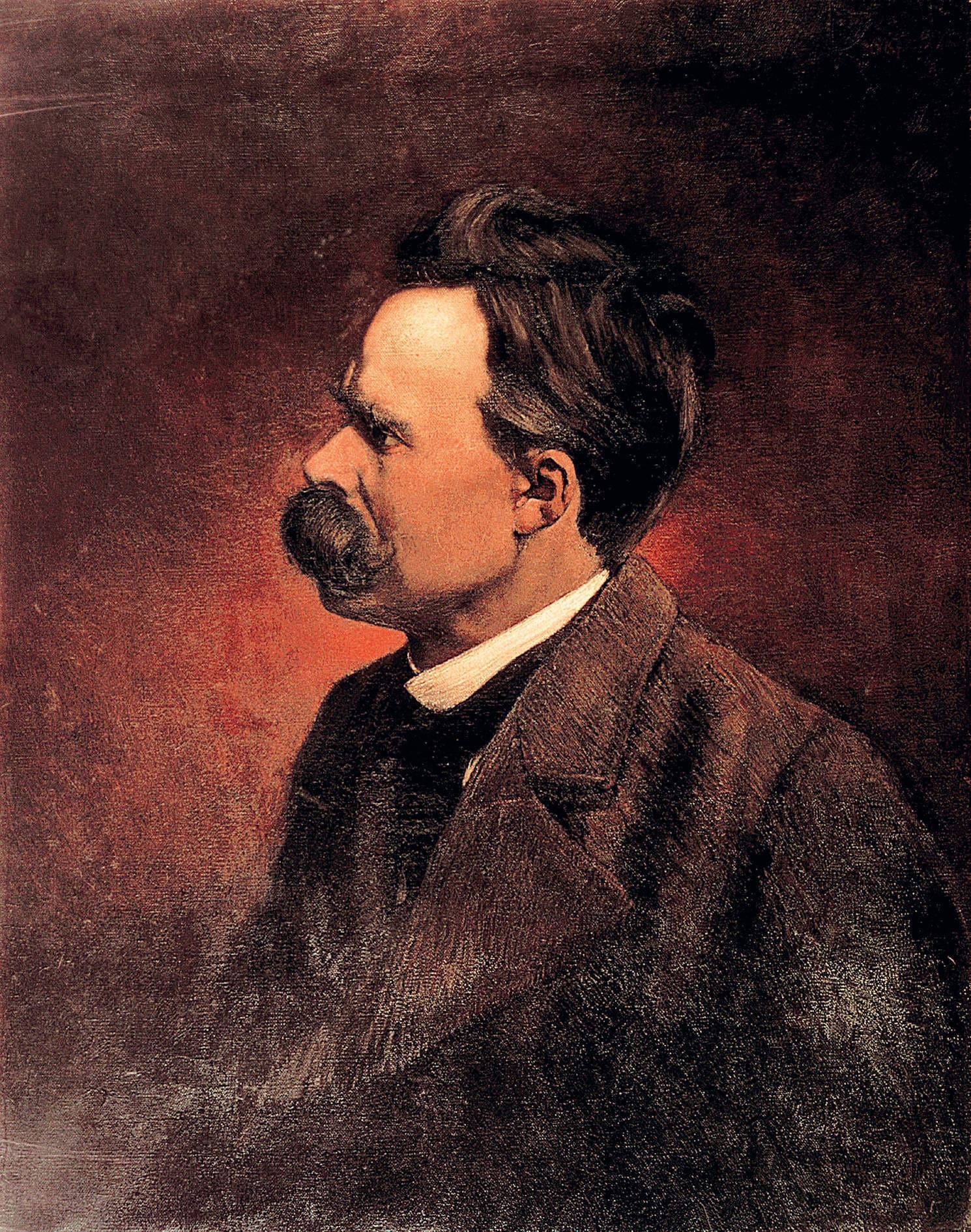
Reducing the thought of a thinker for whom “genius” may be the mildest accurate description to a handful of decorative aphorisms such as “When you go to women, do not forget the whip” or “God is dead,” is to deprive ourselves of a treasure he left behind for a deeper understanding of existence.
Friedrich Wilhelm Nietzsche was not merely a philosopher in the conventional sense, nor simply a metaphysician; he was a teacher of higher human values and a guide to a life filled with virtue, insight, and nobility. What can one learn from him?
The heavy and not always flattering label of “philosopher”—the same one applied to thinkers like John Stuart Mill or Thomas Hobbes—may make Nietzsche at first glance seem an abstract dreamer absorbed in metaphysical puzzles.
Even if one accepts the common view of philosophy as a pursuit of “unanswerable questions” and struggles with the deepest foundations of human existence, Nietzsche’s concerns and ideas encompass a scope far wider than this narrow reading.
In other words, one does not need to be a lover of abstraction and conceptual wrestling to walk through Nietzsche’s universe. Even someone uninterested in philosophy in its usual sense can travel through the towering peaks of his thought and gather precious insights from their slopes.
The marketplace, of course, has not kept its hands off Nietzsche. It has portrayed him as a prophet of moral relativism and the collapse of values. Yet anyone who approaches his words without prejudice or commercial simplifications knows that he sought to rewrite the decaying edifice of Christian morality, not to abolish morality itself. Nietzsche attacked Christian ethics because, to him, it was not moral enough.
He mocked Christian moralists for their condescending attitude toward those who stepped beyond their accepted boundaries. What kind of morality, he asked, is it that does not object to shaming another human being? Nietzsche’s respect for the virtue of shame—its place in the moral life of the individual—is both admirable and astonishing.
His attempt to restore the lost agency of human beings in an age of darkness and nihilism, and his call to rise above the “last man”—a figure that describes many of the small, comfort-seeking individuals around us—reflect a philosophy that is profoundly earthly and illusion-resistant. It is a worldview that tolerates no weakness and insists that “whatever is falling should be pushed.”
Nietzsche held a sacred view of art, and among the arts he considered one supreme: music. He believed that life without music would be a mistake, and saw its highest joy in reaching “the destination—then music, music.” Though he never composed at a piano, his works inspired some of the most enduring pieces of Western classical music.
Stefan Zweig writes in his book Nietzsche that the opening notes of Beethoven’s Ninth Symphony—arguably the most celebrated piece in the history of classical music—were inspired by Nietzsche’s Thus Spoke Zarathustra. The immortal tone poem by Richard Strauss, also titled Thus Spoke Zarathustra, likewise arose from Nietzsche’s vision.
Even reading good translations of Nietzsche reveals his artistry with language: the play of words, the layered meanings, the lightning-flash sentences, and the hidden music within his prose.
This solitary admirer of aloneness was one of history’s last great iconoclasts. Like Abraham breaking the idols, Nietzsche lifted his hammer against the sacred statues humanity had lost the courage to even look at directly. He knew his own destructive vocation well—he was a lone captain writing, as he said, “for the future,” sending shockwaves into the small and comfortable lives of the timid, so unsettling that publishers hesitated to print his works.
Beyond the “idol” the world has built of him—the caricature of a thinker who inspired fascism, promoted antisemitism, approved of beating women, or was an atheist who declared God’s death—there lies the true figure: a towering mind whose insights, whether one agrees with them or not, offer a fresh, life-affirming way of seeing the world, a philosopher who refused to believe in any god who did not know how to dance.
Freedom, noble virtue as opposed to the “slave morality” rooted in transactional meekness, and the forging of a soul from fire—at a time when smoke and ash disguise their own glow—are but some of the gifts that Nietzsche’s rich landscape offers to those who wander through this magnificent terrain.
As Jalal al-Din Rumi might have put it, he is a “sugar-seller” who will never say, “Go away, I have no sugar for you.”