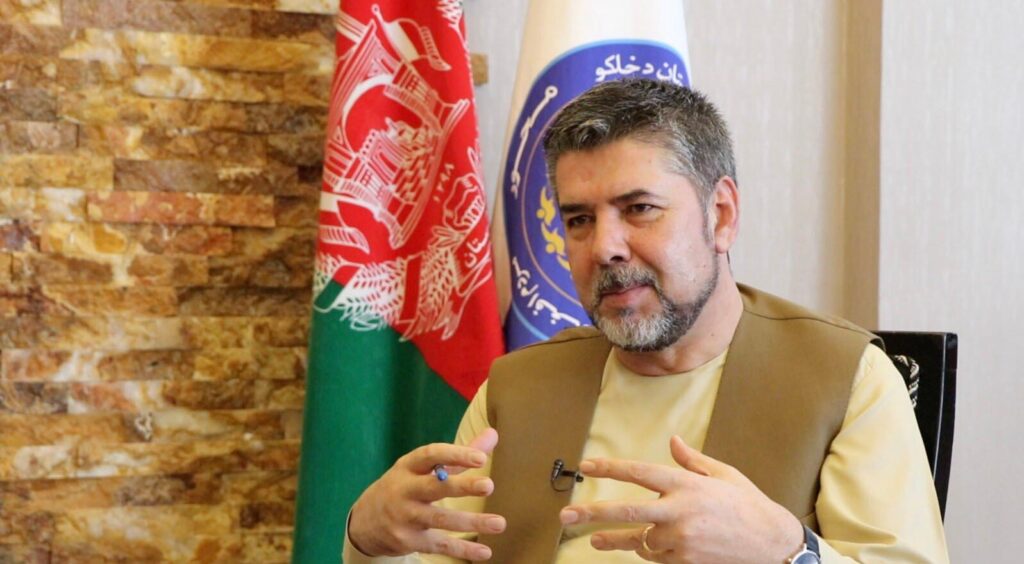
Rahmatullah Nabil, former head of Afghanistan’s National Directorate of Security, has again questioned Mohammad Mohaqiq over why he did not take “such a clear and explicit position” on the Durand Line during the years he held “various positions of power.”
Mohammad Mohaqiq, leader of the People’s Islamic Unity Party of Afghanistan, recently said he recognizes the Durand Line.
His remarks have sparked widespread reactions, and he has sought to defend his stance against criticism.
Some have supported him, arguing that the line was accepted by previous Afghan rulers and accusing the Taliban of politically exploiting the issue, while others say the Durand Line is a “national” matter that requires broad consensus.
In his initial reaction, Nabil said: “Raising such a claim after the public emergence of closer ties with Pakistani military officials and recent correspondence distances it from an independent position and makes it resemble something that smells more like a behind-the-scenes deal than a judgment stemming from an independent political mind.”
Nabil added that the Durand Line is a sensitive historical issue tied to the collective will of the Afghan people, and that determining its future requires a national, transparent, and consensus-based process.
Responding to Nabil, Mohaqiq wrote on his Facebook page: “Mr. Nabil and others… do not shift the burden of your own failures onto the Hazaras. We have not signed any document selling the country’s land, but you have.”
In response, Nabil said: “Given your role and responsibilities in Afghanistan’s political system, we reserve the right to ask: ‘Why now?’”
The former national security chief added: “Your recent correspondence is not new to us. You are well aware of your July 2012 letter to the Pakistani side.”
In another post, Mohaqiq said sarcastically that Shah Shuja in 1838, Mohammad Yaqub in 1879, and Abdur Rahman in 1893 had “sold” parts of the country, adding that “after a century of selling land, there is nothing left for me to sell.”