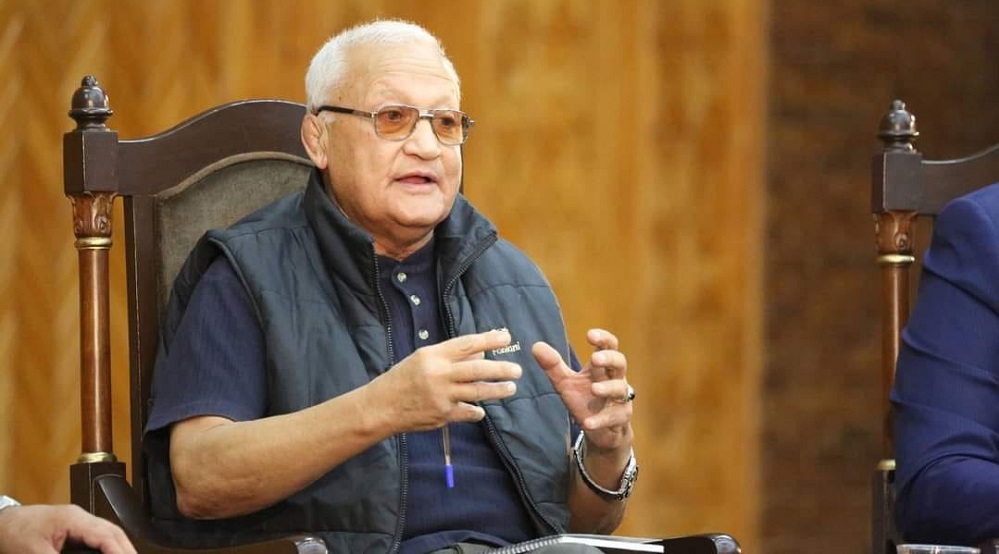
Today marks the 81st birthday of Mohammad Azam Rahnaward Zaryab — one of the few writers whose name is inscribed not only in bibliographies but in the very architecture of modern Afghan literature. Born on August 25, 1944, in Kabul, he grew up in the same city and developed a voice that travelled far beyond the alleys of Rikakhana, ultimately becoming one of the most important voices in Persian storytelling of the past century. Zaryab passed away in Kabul on December 11, 2020, due to illness.
After graduating from the Faculty of Journalism at Kabul University, he travelled to the United Kingdom for further studies. Upon returning to Kabul, he wrote for various newspapers and magazines. In the 1990s, as Afghanistan plunged deeper into civil war, he left for Pakistan and then France, spending years in exile. After the fall of the first Taliban regime, he returned to Kabul and began working with emerging media outlets, including Tolo TV. This combination of journalistic experience and literary creativity shaped his prose into a style marked by precision, observation, and social awareness.
Zaryab’s body of work is exceptionally broad in scope. His short story collections — The Enchanted City, The Man Whose Shadow Left Him, The Horse Thief, And the Rain Was Falling, The Dog and the Gun, and Snakes Beneath the Oleaster Trees — blend ethnographic insight with poetic language, portraying Kabul’s marginalized and sorrow-laden figures in vivid, memorable snapshots. His novels, including Golnar and the Mirror and I Wandered the Four Towers, extend his narrative ambition into longer forms, merging social realism, urban memoir, and touches of the surreal. His essay collections — Margins, The Mute Dreamer, The End of the Three Invulnerable Men, and What We Wrote — reveal his critical and intellectual side, while Shirts showcases his engagement with world literature as a translator.
Stylistically, Zaryab bridged tradition and modernity. His vocabulary and musical prose were rooted in classical Dari, yet his narrative structures, shifting perspectives, linguistic economy, and detailed portrayal of urban complexity placed him firmly within modern storytelling. His bitter humor was never intended for laughter but for exposing reality; his symbolism — especially in describing the city — created an “emotional geography” in which Kabul functioned both as a physical setting and a narrative character. This duality reaches its height in I Wandered the Four Towers, where Afghanistan’s wounded capital becomes a living, memory-bearing presence.
Like many Afghan intellectuals, Zaryab’s life was marked by exile and return. His years in France and his eventual return to Kabul deepened his sensitivity toward themes of homeland lost and regained, collective memory, historical ruptures, and the slow death of urban spaces — themes that lie beneath the surface of his stories.
Zaryab’s influence extended far beyond his texts. For generations of younger writers, he embodied “proof of possibility”: that one could use a local language to speak universally; that beauty and truth could be crafted amid institutional constraints and chronic insecurity. Many young storytellers in Kabul and the provinces — especially during the 2000s and 2010s — considered themselves his “indirect students,” learning from him how to transform suffering into form and form into an ethical testimony about the human condition. Independent studies have confirmed this broad impact, describing him as one of Afghanistan’s most pioneering modern writers and a defender of the Persian language.
His absence created a double void. At the literary level, the loss of a writer who could merge narrative sensitivity with moral clarity at crucial historical moments. At the social level, the silence of a journalist who knew how to extract narrative from news — and from narrative, a clearer picture of society. This void has become even more evident since the Taliban returned to power and media and writers have faced tightened restrictions; the absence of a voice like Zaryab’s comes at a time when Afghan civil and literary life most needs the mediation of memory and storytelling.
Methodologically, Zaryab’s significance lies in redefining the “urban story” in Afghanistan. If earlier generations remained caught between rural romanticism or direct political messaging, Zaryab brought the short story into the realm of everyday observation, fine-grained detail, and the ordinary human being. Faithful to the ethics of narrative, he did not shy away from formal experimentation: manipulating narrative time, blending memory and reality, and shifting perspectives with subtlety. His prose, outwardly simple but inwardly deep, contained all these elements.
The future of Persian literature in Afghanistan is undoubtedly difficult under structural constraints and political pressure. Yet this difficulty turns Zaryab’s absence into a measure for “gauging hope.” His works showed that literature is not only reflection but resistance — not a loud, slogan-driven resistance, but a formal one. A language unafraid of external censorship or internal self-censorship, and a vision that pushes reality toward its highest degree of truth. Even as many writers and poets have been forced into exile or silence, Zaryab’s stories and novels remain an open workshop for new generations — a place to learn how to record the voice of a city, how to extract beauty from loss, and how to speak truth through the limits of language.
Ultimately, Rahnaward Zaryab was a writer who portrayed Afghanistan not through orientalist clichés or political slogans but through tangible human lives and the details of daily existence. His understated humor, restrained imagination, moral clarity, and elegant precision define his style. For this reason, any discussion of the future of Persian literature in Afghanistan inevitably circles back to his name — to the writer who proved that even in the most turbulent chapters of history, one can light a lamp and translate a wounded Kabul, with all its pain and sorrow, into the language of world literature.
The opinions presented here belong solely to the authors and do not represent Deeyar’s editorial stance.