
On September 17 (one month and five days ago), Donald Trump announced he was seeking to reclaim the Bagram airbase. But after widespread regional backlash to the idea — and after a U.S. delegation visited Kabul — it appears he has at least temporarily set the plan aside.
Just days after Trump’s statement, a U.S. delegation led by Adam Boehler, the U.S. Special Presidential Envoy for Hostage Affairs, traveled to Kabul. Before Trump’s threat, both sides had reached an agreement on a prisoner exchange; during the later visit on September 27, one American detainee was released by the Taliban.
This sequence of events has fueled speculation that Trump used the prospect of retaking Bagram as leverage to secure the release of American citizens.
Although Trump has not repeated the idea in the past month, regional states remain firmly opposed — a factor that may also have influenced his temporary retreat.
Trump is known globally for abrupt shifts in position. On the Ukraine war, for example, he has repeatedly reversed his views — sometimes within days.
Some analysts believe that reclaiming Bagram would harm the United States more than it would benefit it. They say the goals Trump cites could be achieved through far “less costly” means.
Regional Opposition to the U.S. Plan
Russia, China, Iran, and Pakistan issued a joint statement on September 24 strongly opposing any foreign military base in Afghanistan. They declared their “renewed opposition to the establishment of military bases by extra-regional forces in or around Afghanistan under any pretext, viewing it as harmful to regional peace and security.”
By October 6, even more countries had voiced opposition. India, Iran, Kazakhstan, China, Kyrgyzstan, Pakistan, Russia, Tajikistan, and Uzbekistan — in the “Moscow Format” meeting — declared that “attempts by certain countries to deploy military infrastructure in Afghanistan or its neighboring states” were unacceptable.
Russian and Iranian officials have been the most vocal critics.
Taliban’s Reaction
After several days of silence, the Taliban finally issued an official statement regarding Trump’s proposal to retake Bagram.
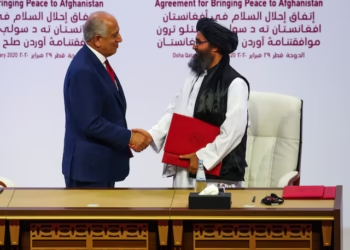
The group said the United States must adhere to the Doha Agreement, which obligates it to refrain from using “force or threats against Afghanistan’s territorial integrity and political independence” and from interfering in its internal affairs.
Zabihullah Mujahid, the Taliban spokesman, told Al Arabiya that Bagram is an “inseparable part” of Afghanistan and that the group would “never” hand it over to anyone.
He added that the “people of Afghanistan” are accustomed to “bad events” after 20 years of U.S. military presence.
Mujahid warned: “Americans must not forget that bad events bring bad reactions… If they insist on using force over Bagram, Afghanistan has its own stance. Defending our country, our national dignity, and our people’s values has been our duty for the past 20 years — and it will remain so.”
The opinions presented here belong solely to the authors and do not represent Deeyar’s editorial stance.