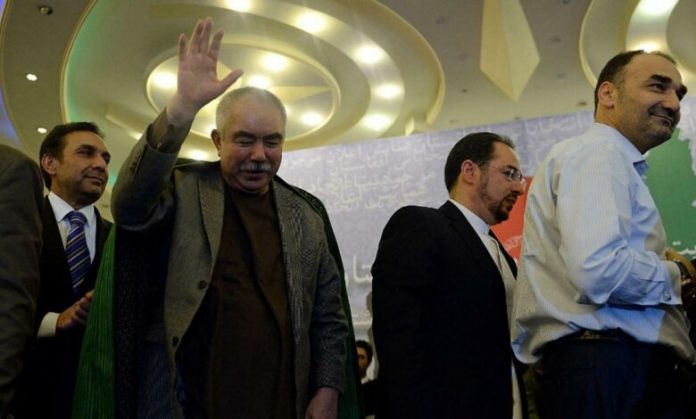
As the fourth anniversary of the Republic’s collapse approaches, a central question resurfaces: why did Afghanistan’s traditional parties and jihadi leaders—despite decades of claims about resistance and sacrifice—fail to mount an effective defense in the final days and weeks of the state? Although symbolic acts of resistance appeared, none translated into meaningful military or political outcomes. Ismail Khan fought in Herat but was captured on August 13; Mazar-e Sharif fell without resistance on August 14, prompting Atta Mohammad Noor and Abdul Rashid Dostum to flee toward Uzbekistan. And on the day Kabul fell, Pakistan flew several Afghan political figures to Islamabad on a charter plane—ostensibly for “talks.”
This analysis avoids moral judgment and instead offers a structural and historical reading of behaviors that shaped a turning point in Afghanistan’s political future.
The jihadi movements of the 1980s were fundamentally networks of identity and ideology, not program-oriented political organizations. After 2001, these networks failed to transform into modern parties with internal elections, financial transparency, and governance platforms. Instead, they were absorbed into the state machinery and its “patronage economy.” The war economy morphed into a rent economy, where ministries, contracts, quotas, and privileges became the currency of political success. In such a system, parties ceased to be factories of policy and cadre-building and turned into shareholding companies of power: personalities overshadowed institutions, loyalty replaced norms, and short-term bargaining eclipsed long-term strategy.
Within this environment, the Doha negotiations—effectively sidelining Kabul from the core decision-making process—sent a clear signal to traditional actors that the transfer of power was inevitable. When a state’s principal foreign sponsor signals departure, and conflicting messages circulate from regional capitals, local cost-benefit calculations shift toward caution and self-preservation. Leaders and their inner circles, deeply embedded in networks of state and economic privilege, avoided large-scale mobilization to protect their wealth, family security, and economic structures. Put simply, “survival rationality” replaced political initiative.
Aging leadership and organizational erosion further weakened resistance. Over two decades, most jihadi groups did not undergo generational renewal. Younger, educated cadres were absorbed into the bureaucracy or pushed to the margins. Without a functioning command chain or mobilization mechanism, none of these groups could move beyond individual statements. Personal rivalries and internal fractures eroded even minimal cohesion, delaying any collective response. Moreover, the political culture shaped during years of post-2001 “elite bargaining”—dominated by quotas and fragile coalitions—translated in crisis into local deals, negotiated surrenders, and city handovers. The same logic that rewarded short-term compromise in times of abundant rents made the cost of resistance appear irrational when scarcity arrived.
At the same time, memories of the civil war in the 1990s and fear of its return pushed many toward preferring a “soft transfer.” This choice appeared humane and responsible but rested on flawed assumptions: guaranteed inclusion in the new order, trust in the Taliban’s stated commitments, and a misreading of the morale collapse unfolding within the security and administrative apparatus. In practice, the capital detached from the provinces, and no bridge of trust or coordination remained.
Still, fairness requires distributing responsibility more widely. Successive governments, through corruption and exclusion; foreign partners, through a flawed exit strategy and unilateral negotiation; and segments of the technocratic elite and civil society, through disregard for social cohesion—all contributed to the collapse. Yet the role of traditional parties and jihadi leaders remains central: their failure to modernize, cultivate successors, prioritize programs over personal bargains, and act decisively in a historic moment shaped the outcome. In political science language, they remained trapped in “local optima”: protecting immediate networks and tangible assets over assuming the short-term costs of legitimate and organized mobilization. Their silence was the product of structure, not merely individual choice.
From this structural reading, however, emerges a roadmap for reform. A genuine political party must step out of the mold of a family-run power company and become a program-oriented organization—with a clear charter, internal elections, term limits, and transparent, publicly audited finances. Financial independence underpins political independence; moving away from rent-based economies through small, transparent funding mechanisms can be a beginning. Generational and intellectual renewal is essential: real power-sharing with younger members, meaningful inclusion of women in decision-making, and the establishment of political think tanks for cadre development would shift parties from loyalty-based structures toward merit-based ones. Rebuilding the party’s link with the periphery requires real provincial offices, elected local councils, and bottom-up accountability. At the national level, a minimal political covenant is needed—defining red lines around citizenship rights, competitive participation, and the prohibition of violence for power, raising the social cost of violating these principles. And above all, historical transparency: an uncensored oral archive of the Republic years and honest acknowledgment of mistakes could create the moral capital needed for legitimate mobilization in future crises.
This piece is not a manifesto of blame. It is an invitation to collective reflection—on what happened, and what can be done. If leaders and parties were unable or unwilling to act then, they can now explain why; if they watched in silence, they can assume responsibility; and if they still believe in a pluralistic future, they must demonstrate it through organizational behavior and political programs. The collapse of that day was not merely the fall of a government—it was the shattering of a social contract in which all of us, to varying degrees, shared responsibility. Rebuilding that contract will require real party-building, public ethics, and a national vision. The path is difficult but clear—and its first step is truth and accountability.