Since the Taliban’s return to power in Afghanistan, the systematic removal of women from public life has begun swiftly and without interruption. This erasure is not merely a restriction of women’s roles but a full-scale project aimed at denying the social existence of women. In the Taliban’s system, the exclusion of women is not a temporary policy but the ideological core of their governance—a power that secures itself through the methodical cleansing of half the population.
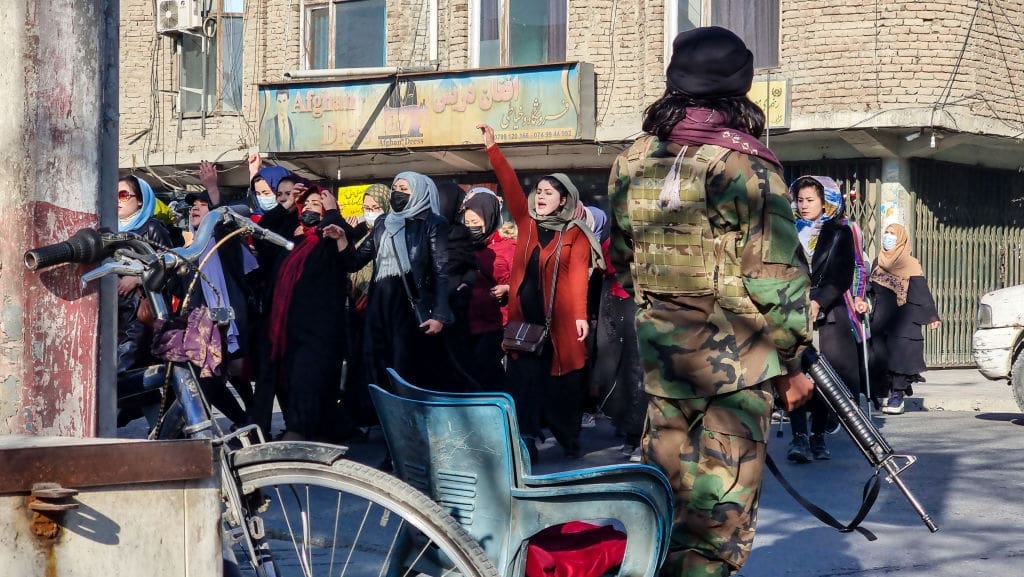
Today, women in Taliban-controlled Afghanistan are deprived not only of schooling and university education but also of their most basic human rights: the right to work in government and many non-government sectors, the right to move freely in public spaces, to seek medical care, or to enter public and recreational areas without a male guardian. In the latest stage of this policy, the arbitrary detention of women in Kabul—simply for appearing in public—has reached its peak, functioning as a form of “physical cleansing” that removes women from urban spaces and symbolically erases them from social existence.
From a jurisprudential perspective, Taliban practices have no grounding in the established principles of Sunni jurisprudence—particularly Hanafi fiqh, which the Taliban claim to follow. Hanafi law emphasizes the presumption of innocence and holds that no one may be punished or detained without proven wrongdoing before a legitimate court with the right to defense. Women, as moral agents with autonomy under Islamic law, have the right to appear in public unless a clear judicial ruling states otherwise. What the Taliban perform under the banner of “commanding virtue” violates these foundations: it is neither based on clear evidence of wrongdoing nor carried out through legitimate channels, nor does it follow the graded procedural requirements set in classical jurisprudence.
Even on the question of hijab, the Taliban have departed from its ethical and devotional meaning, transforming it into an instrument of coercive political discipline. Islamic scholars broadly agree that hijab, before being a state-imposed obligation, is an ethical duty rooted in individual moral agency. What the Taliban enforce as “social order” is, in reality, an ideological form of authoritarian control rather than a jurisprudential norm.
Sociologically, the exclusion of women is not merely gender discrimination—it represents a complete structural collapse. Healthy social systems require the active participation of all members. Systematic removal of women shuts down half of Afghanistan’s productive, cultural, social, and intellectual capacity. Social engagement, cultural reproduction, and the transmission of values become fundamentally impaired. What the Taliban have created is a “single-gender order,” rare even among traditional theocratic regimes.
Meanwhile, the international community—despite repeatedly condemning the Taliban’s violations—has in practice contributed to the normalization of this repression through silence or symbolic gestures. International human rights institutions, including the UN Human Rights Council, the Commission on the Status of Women, and CEDAW, have classified Taliban policies as grave violations of human rights and a form of gender apartheid. Yet no binding or effective action has been taken to curb this trajectory.
Under international law, many Taliban practices fall under categories of crimes against humanity: systematic exclusion of women from public life, denial of education, restriction of movement, and deprivation of healthcare, all in violation of core human rights instruments such as the ICCPR, the Universal Declaration of Human Rights, and the Convention on the Rights of the Child.
In conclusion, the Taliban have not merely marginalized women; they have removed them from social existence at every level—physical, institutional, intellectual, legal, cultural, and civilizational. Words like “discrimination” or even “persecution” are insufficient; what is unfolding in Afghanistan is a deliberate, systematic project of erasing women.
Resisting this reality requires two urgent actions: first, raising awareness—especially in Muslim societies—about the nature and depth of this erasure, to dispel confusion between faith and authoritarian power; and second, amplifying the voices of Afghan women regionally and globally, ensuring that the Taliban’s religious and social narratives do not remain uncontested. This is not merely an internal crisis—it is a moral test for the contemporary world. A world that remains silent becomes not an observer, but an active partner in injustice.
The opinions presented here belong solely to the authors and do not represent Deeyar’s editorial stance.