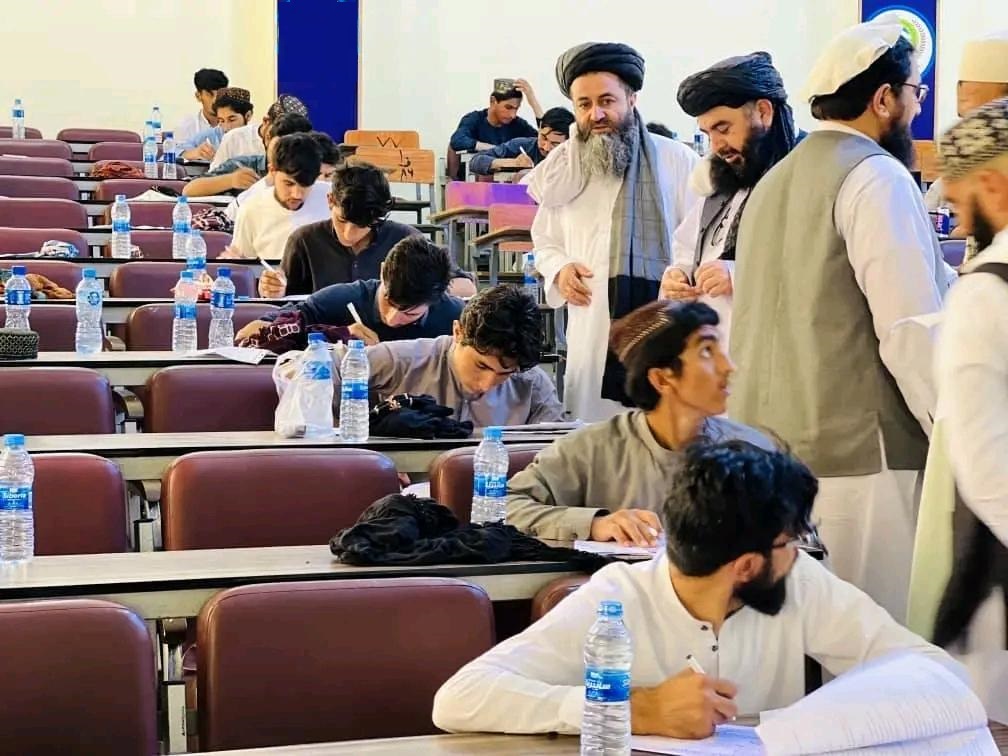
The announcement of nationwide Kankor exam results is a moment that deserves to be viewed beyond ranks and fields of study. Today, as the list of the top ten candidates was released, one striking pattern stands out: almost all of them either studied in Kabul, were raised in Kabul, or now plan to continue their higher education there. Kabul appears to be not only the political capital of the country but also the capital of education and the Kankor itself.
My own experience tells me that it is rare to find someone educated in a second- or third-tier province whose name appears among the top ten or even top twenty Kankor scorers. This is no coincidence. Exceptional performance in the Kankor is seldom the product of individual effort alone; it is the outcome of living in an environment where the educational ecosystem collectively nurtures talent. We do not grow in isolation. When surrounded by highly motivated and competitive peers, their ambition becomes contagious, pushing everyone forward together. But in an environment where education is weak, competition is limited, and the goal is reduced to “simply passing,” the outcomes naturally differ.
In Kabul—and a few other first-tier provinces—such ecosystems exist. Many students migrate to these cities specifically to access these learning environments, even before taking the Kankor. Kabul has become a magnet for talent, gradually widening the gap between center and periphery. Put simply: a student educated in Kabul will almost inevitably stand on a different rung of the results ladder than one educated elsewhere.
Kankor results also highlight something more. Success is not tied to ethnicity, sect, or gender. While these social variables may create barriers, the students who break through demonstrate how far stereotypes about ability diverge from reality. In earlier years, girls were often among the top scorers—loudly reminding society that “ignorance” and “excellence” must be understood through structures, not through inherited traits.
But now, for four years, girls have not even been allowed to compete. Their absence is not silent; it is an absence that cannot be concealed. One wishes someone were still here to carry that message forward today.
Another dimension is the way the Kankor has reinforced a certain type of monopoly. In Afghan society, talent has become synonymous with medicine and engineering. Those who work hardest, study most, and are intellectually strongest overwhelmingly choose one of these two paths. This is not a trivial issue. When candidates are allowed five program choices, “education” is usually placed at the very bottom—not out of interest, but out of resignation.
The result? Future schoolteachers often emerge from applicants whose capabilities—at least according to the current system—are below average. This cycle continuously reproduces the weaknesses of the educational system. One who has never received quality education cannot provide it. And so we end up knowing no prominent psychologists, sociologists, or economists who were fully shaped within this system. Fields outside medicine and engineering grow weaker and emptier every year.
In this sense, the Kankor is not merely a competition of talent; it is a mirror reflecting unhealthy structures, geographic disparities, and cultural beliefs about what counts as success. If we hope to change this cycle, we must rethink not only the curriculum but also the assessment mechanisms, social expectations, and educational policies at their foundations.
The opinions presented here belong solely to the authors and do not represent Deeyar’s editorial stance.